Kollect architecture
Kollect is a Kubernetes operator that turns selected, live cluster state into a durable, queryable, diffable inventory — decoupled from the apiserver's availability, RBAC, and scale limits — so portals, automation, and auditors read export data, never the live API.
Summary for implementers: PLATFORM-DECISIONS.md · ADR: adr/0201-crd-model.md
Project maturity
Kollect is pre-beta (v1alpha1). Phases in this document describe build order, not GA
release milestones. See ROADMAP.md for current implementation status.
Problem statement
Kubernetes is the source of truth for what is running, but a poor system of record for it. The apiserver is built for control loops, not for portals, audits, and analytics: it is live and ephemeral, RBAC-gated, etcd size-limited, schema-rigid, and per-cluster. Pointing stakeholders at it directly has four recurring consequences:
- Availability coupling — portal views depend on unbounded kube-apiserver list/watch and on cluster uptime/RBAC.
- No history — raw API access yields no audit-friendly, diffable, point-in-time record.
- Schema rigidity — hardcoded collector schemas break whenever a new CRD or attribute is needed.
- Fleet storms — naive per-cluster export produces N export/commit storms per logical change.
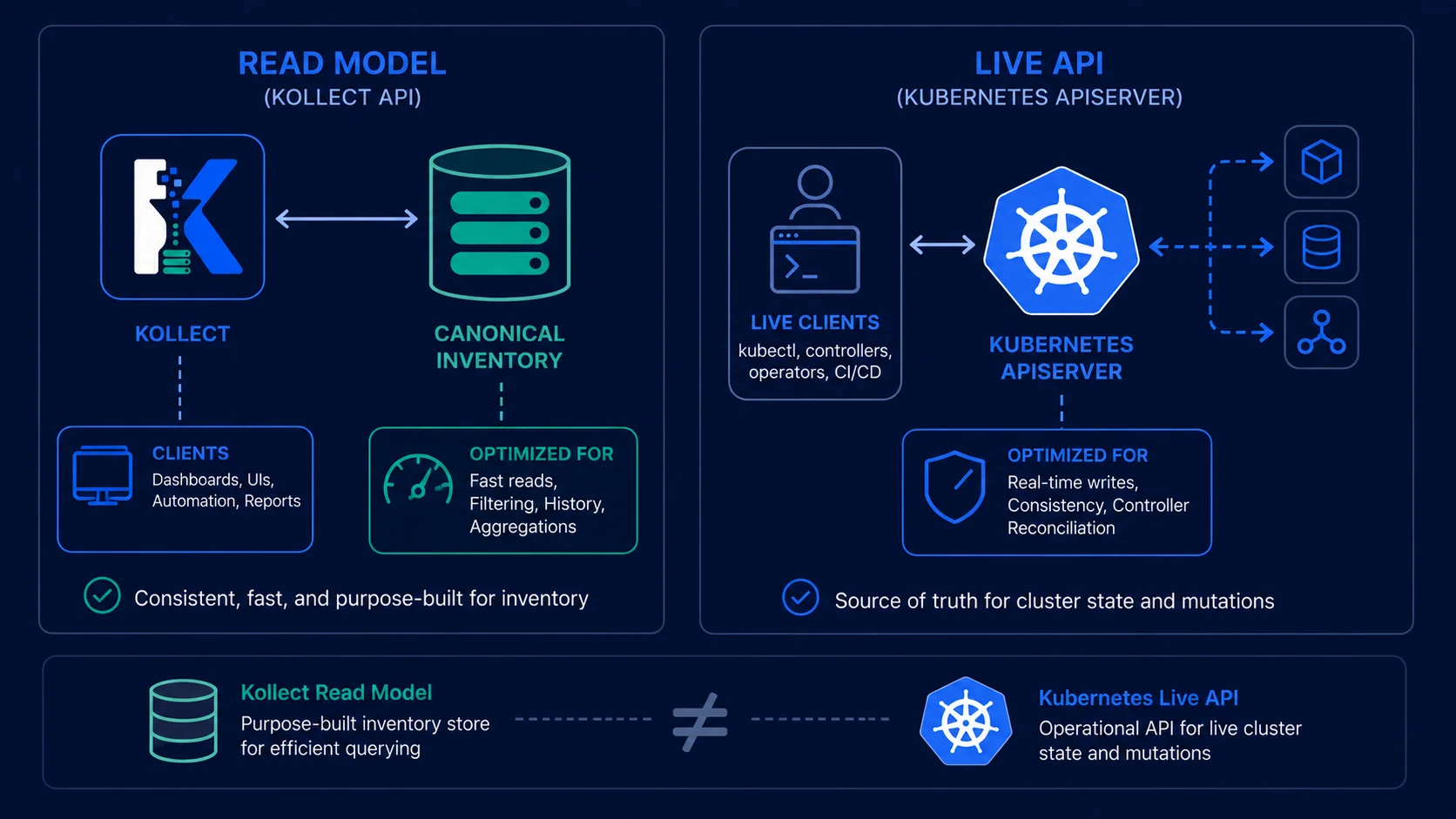
Kollect resolves this by maintaining a read model of the cluster: select resources by GVK → extract the attributes that matter via CEL/JSONPath → aggregate in memory across targets (and, optionally, clusters) → debounce → export to role-based pluggable sinks. The per-inventory in-memory snapshot is canonical; every sink — relational store, object/Git snapshot, or event stream — is a projection of it (ADR-0401), so no single backend is privileged. Inventory is configuration, not code, owned per-team in its own namespace. Rendering and publishing docs/CMS stays outside the operator (ADR-0702).
Full first-principles argument (options weighed, users, assumptions): REQUIREMENTS.md.
CRD model
flowchart TD
  subgraph teamNs [Team namespace — default]
    Profile["KollectProfile"]
    Snap["KollectSnapshotSink"]
    Db["KollectDatabaseSink"]
    Ev["KollectEventSink"]
    Scope["KollectScope"]
    Target["KollectTarget"]
    Inv["KollectInventory"]
    ConnTest["KollectConnectionTest"]
  end

  Profile --> Target
  Scope -.-> Target
  Scope -.-> Inv
  Target -->|"shared informer per GVK"| K8s["Kubernetes API"]
  Target --> Inv
  Inv --> Snap
  Inv --> Db
  Inv --> Ev
  ConnTest -.-> Snap
  ConnTest -.-> Db
  ConnTest -.-> Ev
  Db --> DB["Postgres · MongoDB (relational SoR)"]
  Ev --> Stream["Kafka (event emitter)"]
  Snap --> Git["Git · GitLab · S3 · GCS (snapshot store)"]
Inv -.->|"optional, gated"| HTTP["HTTP debug API"]| Kind | Scope | Reconciled | Purpose |
|---|---|---|---|
KollectProfile |
Namespace | No | Extraction schema (ADR-0204) |
KollectSnapshotSink |
Namespace | Probe only | Snapshot export; ConnectionVerified (ADR-0414) |
KollectDatabaseSink |
Namespace | Probe only | Relational SoR export |
KollectEventSink |
Namespace | Probe only | Event emitter export; platform-shared backends published in kollect-system |
KollectScope |
Namespace | No | Tenancy boundary (ADR-0203) |
KollectTarget |
Namespace | Yes | Team-scoped collection (default) |
KollectClusterTarget |
Cluster | Yes | Platform cross-namespace collection (ADR-0201) |
KollectInventory |
Namespace | Yes | Aggregate namespaced targets; export to sinks |
KollectConnectionTest |
Namespace | Yes | Audited sink/profile connectivity probes (ADR-0201) |
~~KollectSink~~ |
— | — | Removed — family CRDs (ADR-0414) |
~~KollectClusterProfile / KollectCluster*Sink~~ |
— | — | Removed — cluster kinds reference namespaced config by name + namespace (ADR-0208) |
KollectClusterInventory |
Cluster | Yes | Platform rollup — pairs with KollectClusterTarget |
KollectClusterScope |
Cluster | No | Platform policy boundary (ADR-0207) |
~~KollectHub~~ |
— | Rejected / stub | Removed from tree — was never product surface |
~~KollectPublication~~ |
— | Rejected | ADR-0702 |
See adr/0201-crd-model.md. Per-kind field reference: CR-REFERENCE.md. Reserved kinds are design placeholders — see PLATFORM-DECISIONS.md.
Default deployment
Recommended install
Per-team Helm with tenantMode: true and watchNamespaces: [team-ns] is the documented
default for new installs. Platform-wide cluster operator remains supported for cross-namespace
collection via KollectClusterTarget.
Same-namespace sink refs
KollectInventory family sink refs must name family sink objects in the same namespace as the
inventory. Cross-namespace sink references are rejected at admission.
Reconciliation flow
sequenceDiagram
  participant API as Kubernetes API
  participant Inf as Shared informer (per GVK)
  participant Tgt as KollectTarget
  participant Store as In-memory collect store
  participant Inv as KollectInventory
  participant Sink as Sink families (snapshot · database · event)

  API-->>Inf: watch events
  Inf->>Tgt: enqueue
  Tgt->>Store: upsert rows
  Tgt->>Inv: trigger aggregation
  Note over Inv: debounce export window
  Inv->>Sink: serialized payload
  Inv->>API: status metadata only
Key properties:
- Event-driven informers (ADR-0301) — one informer per GVK.
- Watch opt-in/out (ADR-0205) — platform
watchMode: All; teams exclude withkollect.dev/watch: disabled. - Export debouncing — store updates immediately; sink export coalesced (ADR-0201).
- Status holds summaries only — full payload in sinks (ADR-0103).
- HTTP inventory — optional, off by default; debug/small installs only.
Diagrams: collection, debouncing, scope gates, and connection-test lifecycle — DATA-FLOWS.md.
Where inventory lives
| Layer | Durability | Role |
|---|---|---|
| Informer + collect store | Pod lifetime | Live collection |
KollectInventory.status |
etcd | Counts, conditions, export refs |
| Postgres / Kafka sink | Durable | System of record for portals |
| Git sink | Durable | Audit / diff |
| HTTP (if enabled) | Ephemeral | Debug snapshot |
Sinks (by role)
Classified by role, not vendor (ADR-0401). The in-memory snapshot per Inventory is canonical; sinks are projections.
- Snapshot stores — Git (audit), S3/GCS Parquet (queryable via DuckDB, no DB server), HTTP (debug). Deletes free.
- Relational SoR — Postgres (rich portal SQL; needs delete reconciliation).
- Event emitters — NATS JetStream (lean default), Kafka/Redpanda (enterprise opt-in). Doubles as multi-cluster fan-in.
- GitLab — Phase 2 enterprise Git host (internal CA via
tls.caSecretRef).
Multi-cluster (build order)
Fleet vs single-cluster
Single-cluster installs export directly to Postgres, Git, or event sinks — no central merge
tier. Fleet topologies deploy one operator per cluster; each writes debounced inventory
snapshots to a shared sink keyed by spec.cluster on family sink CRDs
(ADR-0501). Walkthrough:
Multi-cluster fleet example.
Phases in docs are build order, not release milestones — see PLATFORM-DECISIONS.md.
Connection test
KollectConnectionTestCR — primary for CI/audit (ADR-0201)- Sink
connectionTest+ annotation — supplementary quick checks (ADR-0403)
Package boundaries
Domain code under internal/ is grouped into components (controller, collect, aggregate,
sink, inventory, export, scope, validation, webhook, and shared utilities). The CRD
types in api/v1alpha1 are a separate component every layer may import.
Intended dependency flow (simplified):
api/v1alpha1  ←  controller  →  collect, aggregate, sink, scope, validation, export
collect, aggregate  →  (no controller, no sink)
sink  →  export (not controller)
cmd  →  wires everything
CI enforces this graph with go-arch-lint via
task arch-lint (also part of task lint). Rules and any baseline todo(arch-NN) exceptions are
declared in .go-arch-lint.yml. Maintainer setup:
tooling-setup.md.
Regenerate the visual overview with task arch-lint:graph (DI view, vendors included). The SVG is
checked in at architecture-graph.svg:
The graph shows component dependencies (--type di): arrows point from a component to what it
imports. Green vendor nodes come from the vendors / canUse blocks in .go-arch-lint.yml when
rendered with --include-vendors. For the reverse (execution-flow) view, use
task arch-lint:graph:flow.