Kollect data flows¶
Visual walkthroughs of how data moves through the operator. For CRD roles see ARCHITECTURE.md; for locked decisions see PLATFORM-DECISIONS.md.
Sink roles on export paths
Export fans out to whatever sinkRefs name — each sink has a role (snapshot store, relational
SoR, or event emitter), not a fixed Postgres+Kafka pair
(ADR-0401). Diagrams below may show Postgres and
Kafka as examples; hub and inventory export use the same role-based contract for all seven shipped
types.
1. Export debouncing¶
Problem: Event-driven informers can fire hundreds of updates per minute. Without coalescing, every watch event would trigger a Postgres upsert or Git commit.
Design: The in-memory collect store updates immediately on every target reconcile. Only the
sink export step is debounced per sink ref on KollectInventory (ADR-0413).
One payload is marshalled per reconcile; each ref exports when its effective interval elapses or the
checksum/generation bypass rules fire for that sink.
Per-inventory state machine¶
flowchart TD
  Start([Inventory reconcile]) --> Scope{In KollectScope?}
  Scope -->|no / not enforced| SinkOK{Sink reachable?}
  Scope -->|violation| Degrade[Degraded — no export]
  SinkOK -->|no| Degrade
  SinkOK -->|yes| Marshal[Marshal namespace payload]
  Marshal --> Size{Within maxExportBytes?}
  Size -->|no| Degrade
  Size -->|yes| Hash[Compute payload checksum]
  Hash --> Gen{generation changed?}
  Gen -->|yes| Export[Export to sinks now]
  Gen -->|no| Chk{checksum changed?}
  Chk -->|yes| Export
  Chk -->|no| Interval{elapsed ≥ exportMinInterval?}
  Interval -->|yes| Export
  Interval -->|no| Wait[RequeueAfter remainder]
  Export --> Status[Update status: lastExportTime, conditions]
  Wait --> Start
Timing example (default exportMinInterval: 30s)¶
sequenceDiagram
  participant API as Kubernetes API
  participant Store as Collect store
  participant Inv as KollectInventory
  participant PG as Postgres sink

  API->>Store: Deployment image patch (t=0s)
  Note over Store: row updated immediately
  Store->>Inv: trigger reconcile
  Inv->>PG: export (checksum changed)

  API->>Store: unrelated resync (t=5s)
  Store->>Inv: trigger reconcile
  Note over Inv: same checksum — debounced
  Inv-->>Inv: requeue ~25s

  API->>Store: second patch (t=12s)
  Store->>Inv: trigger reconcile
  Inv->>PG: export (checksum changed — bypass interval)

Note over Inv,PG: identical payload at t=40s → export allowed (30s elapsed)Configuration¶
Effective interval per sink ref (ADR-0413):
effectiveInterval(ref) =
  max(
    ref.exportMinInterval ?? sink.exportMinInterval ?? inventory.exportMinInterval ?? 30s,
    scope.minExportInterval ?? 0s
  )
| Field | Default | Effect |
|---|---|---|
spec.sinkRefs[].exportMinInterval |
— | Per-sink override (string refs inherit inventory default) |
KollectSink.spec.exportMinInterval |
— | Sink default when ref and inventory omit override |
KollectInventory.spec.exportMinInterval |
30s (CRD default) | Inventory-wide default for plain string refs |
KollectScope.spec.minExportInterval |
— | Tenancy floor — webhook rejects intervals below this |
metadata.generation bump |
— | Immediate export to all sinks (spec edit) |
| Payload checksum change | — | Immediate export to that sink (material change) |
exportMinInterval: 0s |
— | Material-change only; controller requeues with 30s watchdog |
Interval semantics¶
exportMinInterval is a debounce for identical payloads, not a rate limit:
- Material changes always export immediately. A payload checksum change or a
metadata.generationbump bypasses the interval for that sink, regardless of the configured value — even1hnever delays a changed payload. - The interval only throttles re-export of an unchanged payload. With
30s, an identical payload is re-sent at most every 30s; distinct payloads are not rate-limited. A burst of material changes produces an export per change, modulo natural reconcile coalescing (events that arrive while a reconcile is in flight are batched into the next one). 0sis valid and means material-change only: instant export on change, identical payloads are never periodically re-sent. The controller still requeues on a 30s watchdog (ZeroIntervalWatchdog) to keep status fresh — the watchdog does not re-export.- Sub-second values are accepted (validation allows any non-negative duration up to 24h,
e.g.
500ms), but requeue wake-ups are floored at 1s, so identical-payload re-export effectively ticks at ≥ 1s. Since changed payloads bypass the interval anyway, sub-second values buy nothing over0s.
Dual-cadence fan-out
Portal Postgres at 30s plus Git audit at 1h is the canonical multi-role pattern — see
config/samples/kollect_v1alpha1_kollectinventory.yaml
and deployment-inventory example.
Event sinks (Kafka/NATS) usually want exportMinInterval: 0s — emit on material change only,
never re-publish an identical payload.
When some sinks export and others are debounced, aggregate Synced=False with reason
PartiallySynced; per-sink detail lives in status.sinkExports[].
2. Collection pipeline¶
How a watched object becomes an inventory row.
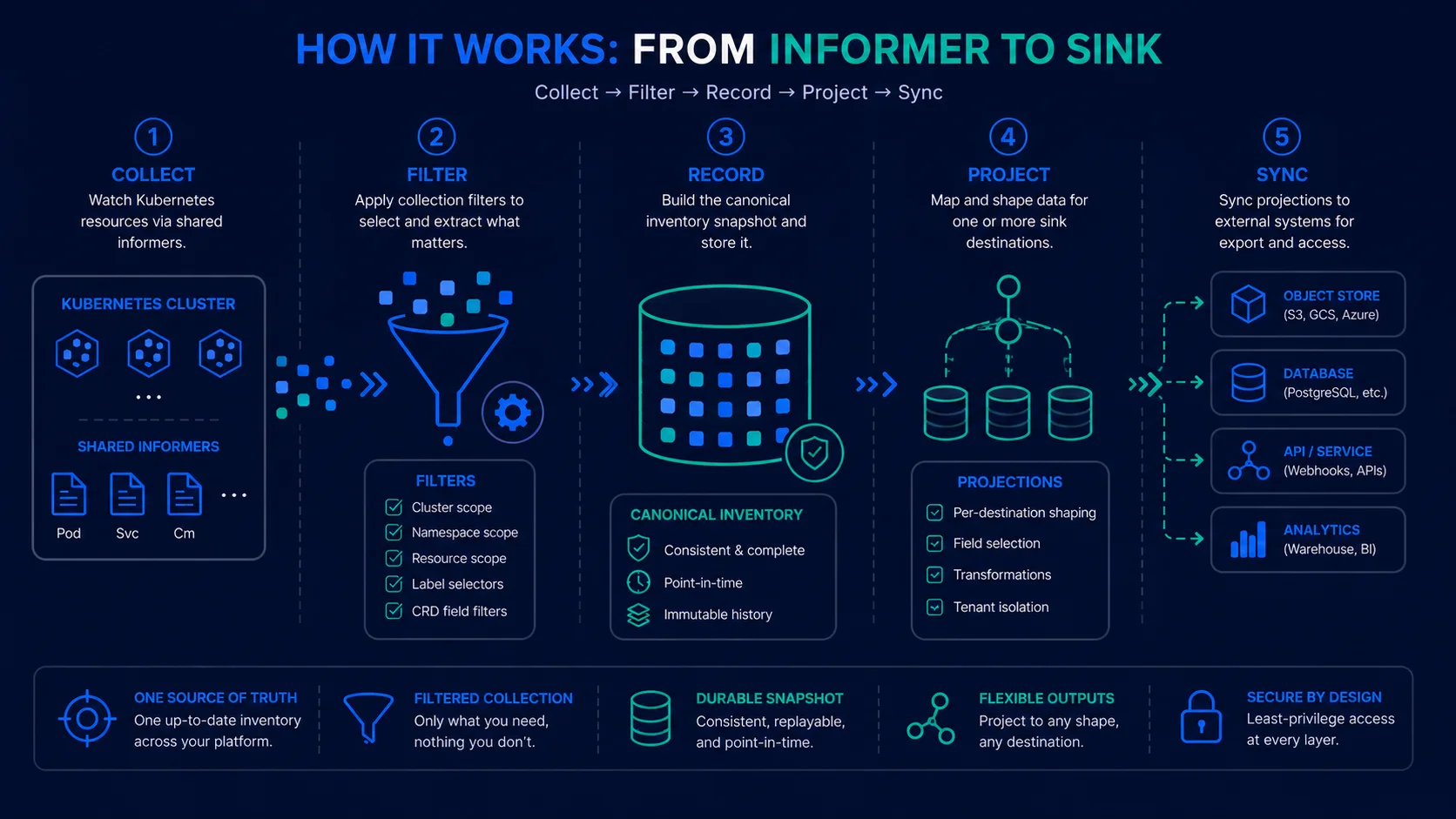
flowchart LR
  subgraph api [Kubernetes API]
    Obj[Deployment / CRD / …]
  end

  subgraph operator [kollect operator]
    Inf[Shared informer<br/>one per GVK]
    Tgt[KollectTarget<br/>reconciler]
    Prof[KollectProfile<br/>schema]
    Ext[Extractor<br/>JSONPath / CEL]
    Store[(Collect store<br/>per namespace)]
    Inv[KollectInventory]
  end

  Obj -->|watch| Inf
  Inf -->|enqueue| Tgt
  Prof -.->|profileRef| Tgt
  Tgt -->|label/NS filter| Ext
  Obj -.->|cached object| Ext
  Ext -->|attribute map| Store
  Store --> Inv
Key properties:
- One informer per GVK across all targets (ADR-0301).
- Targets only differ by namespace/label selectors and profileRef.
- Extraction runs on the cached unstructured object — no per-target API list calls.
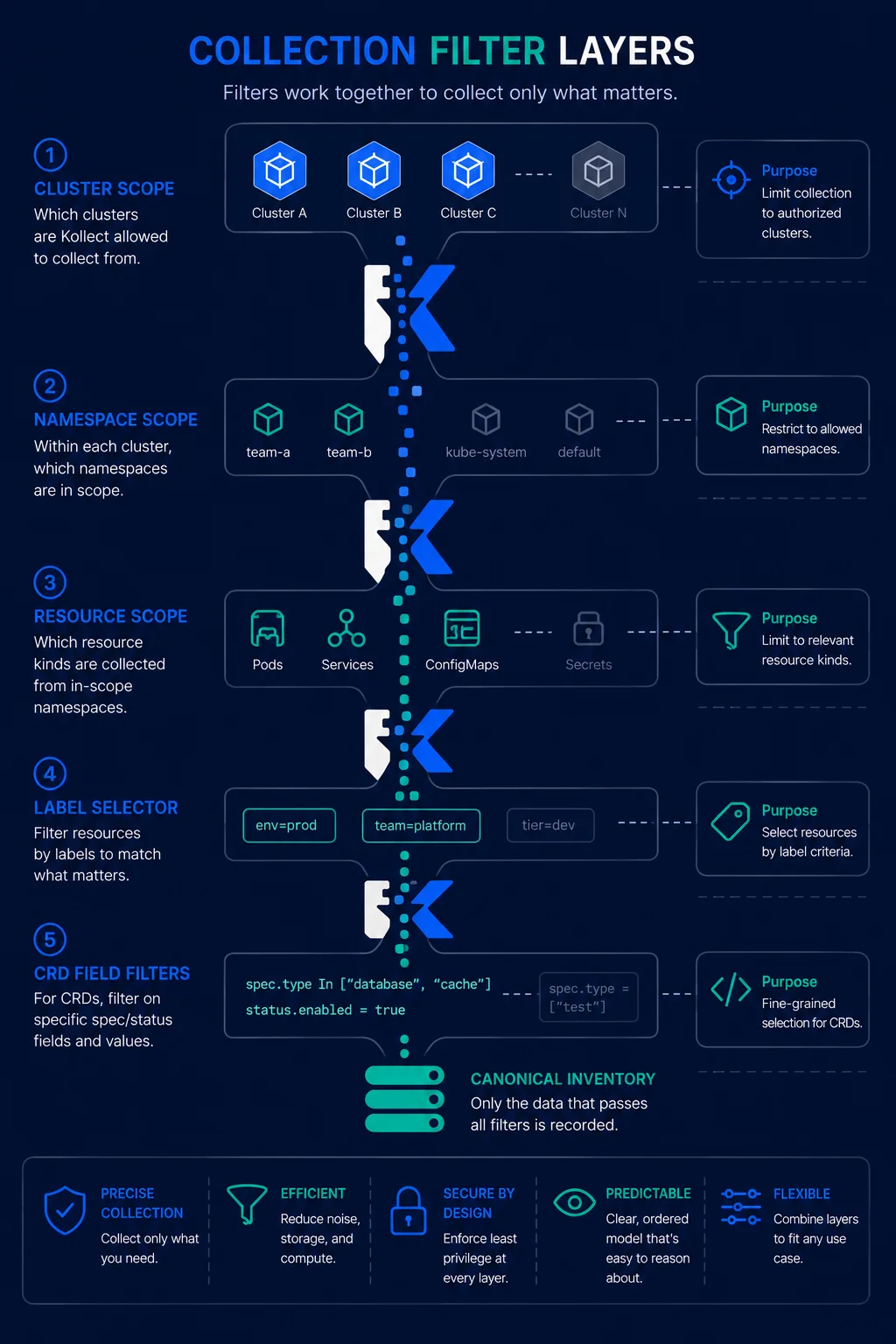
Collection filter layers¶
Before a watched object reaches the collect store, it passes through stacked policy layers — Helm
watch boundary, Scope denials, Target include/exclude intent, resourceRules, CEL matchPolicy, and
watch labels (ADR-0207).
3. Attribute extraction (JSONPath arrays)¶
KollectProfile attributes are evaluated per object. Single-index paths return a scalar; wildcard
paths return a JSON array in the export row.
flowchart TD
  Obj[Unstructured object] --> Path{Path type?}
  Path -->|CEL expression| CEL[CEL evaluator]
  Path -->|JSONPath wildcard| JP[kubectl JSONPath]
  CEL --> Val[Go value]
  JP --> Matches{match count}
  Matches -->|1| Scalar[scalar in row]
  Matches -->|many matches| List[array in row]
  Matches -->|0| Opt{optional?}
  Opt -->|yes| Skip[omit attribute]
  Opt -->|no| Null[null in row]
Deployment containers example:
| Path | Result for 2-container pod |
|---|---|
$.spec.template.spec.containers[0].image |
"app:1.0" (string) |
$.spec.template.spec.containers[*].image |
["app:1.0", "sidecar:2.0"] (list) |
See ADR-0302 for syntax rules.
4. KollectScope enforcement gate¶
Static scope object; enforced at target and inventory reconcile time (hard degrade).
flowchart TD
  Tgt[KollectTarget reconcile] --> Load[Load KollectScope in namespace]
  Load --> Enforced{scope exists?}
  Enforced -->|no| Collect[Register watch + collect]
  Enforced -->|yes| GVK{profile GVK in allowedGVKs?}
  GVK -->|no| DenyT[Degraded ScopeGVKDenied]
  GVK -->|yes| NS{workload NS in allowedNamespaces?}
  NS -->|no| DenyT
  NS -->|yes| Collect

  Inv[KollectInventory reconcile] --> Load2[Load KollectScope]
  Load2 --> Sinks{sinkRefs ⊆ scope.sinkRefs?}
  Sinks -->|no| DenyI[Degraded ScopeSinkDenied]
  Sinks -->|yes| Export[Continue export path]
Example: ADR-0203.
5. KollectConnectionTest lifecycle¶
One-shot probe CR for audited connectivity checks.
stateDiagram-v2
  [*] --> Pending: CR created
  Pending --> Probing: reconciler starts
  Probing --> Succeeded: sink OK
  Probing --> Failed: sink error
  Succeeded --> TTL: status.completed
  Failed --> TTL
  TTL --> Deleted: after ttlSecondsAfterFinished
  Pending --> Probing: spec change (generation bump)
  Succeeded --> Probing: spec change re-probe
  Failed --> Probing: spec change re-probe
Default TTL: 300s. Patch spec.sinkRef to force a fresh probe.
6. Multi-cluster fleet (shared sink fan-in)¶
Each cluster runs the same single-mode operator. KollectInventory export includes a
cluster dimension via spec.cluster on database sinks or {cluster} in Git
pathTemplate so shared backends merge rows without an in-tree aggregation tier
(ADR-0501).
flowchart LR
  subgraph c1 [Cluster A]
    Tgt1[KollectTarget]
    Inv1[KollectInventory]
    Tgt1 --> Inv1
  end
  subgraph c2 [Cluster B]
    Tgt2[KollectTarget]
    Inv2[KollectInventory]
    Tgt2 --> Inv2
  end
  subgraph sink [Shared backend]
    PG[(Postgres PK: cluster + uid)]
    GIT[Git pathTemplate clusters/cluster/…]
  end
  Inv1 -->|export cluster=a| PG
  Inv2 -->|export cluster=b| PG
  Inv1 --> GIT
  Inv2 --> GIT
Merge semantics: Postgres delete reconciliation keys on (cluster, namespace, name, uid).
Git and object-store layouts partition by pathTemplate. Event sinks include cluster in subject
or headers for downstream consumers.
Export path: identical per-sink debouncing as single-cluster mode (§1).
Multi-cluster rows carry cluster in each item; CR status stores summaries only
(ADR-0103).
Walkthrough: Multi-cluster fleet.
See also¶
- ARCHITECTURE.md — CRD model and deployment defaults
- PERFORMANCE.md — metrics and tuning
- examples/deployment-inventory.md — end-to-end walkthrough