Understand the basics
Curated prerequisites before you install Kollect or apply sample custom resources. You do not need to be a Kubernetes expert, but comfort with the concepts below makes QUICKSTART.md and the examples much easier to follow.
Who this page is for
Platform engineers evaluating Kollect on kind, SREs wiring sinks for a tenant namespace, and contributors reading ARCHITECTURE.md. If you already run CRD-based operators daily, skip to Quick start.
Kubernetes fundamentals
Kollect is a namespaced operator — you install one controller deployment (typically via Helm) and declare inventory pipelines as Custom Resources in tenant namespaces.
| Concept | Why it matters for Kollect |
|---|---|
| Pods, Deployments, Namespaces | Sample targets watch Deployment objects; multitenant installs scope by namespace |
RBAC (Role, ClusterRole, ServiceAccount) |
The manager needs list/watch on GVKs your profiles select; SAR checks degrade gracefully |
| Secrets | Git, Postgres, Kafka, and NATS sinks read credentials from spec.secretRef |
| Labels and annotations | kollect.dev/watch opt-in/opt-out (ADR-0205) |
Useful primers:
- Kubernetes basics — official interactive tour
- kubectl cheat sheet —
get,describe,apply -k - kind quick start — local clusters for evaluation
Custom resources (CRDs)
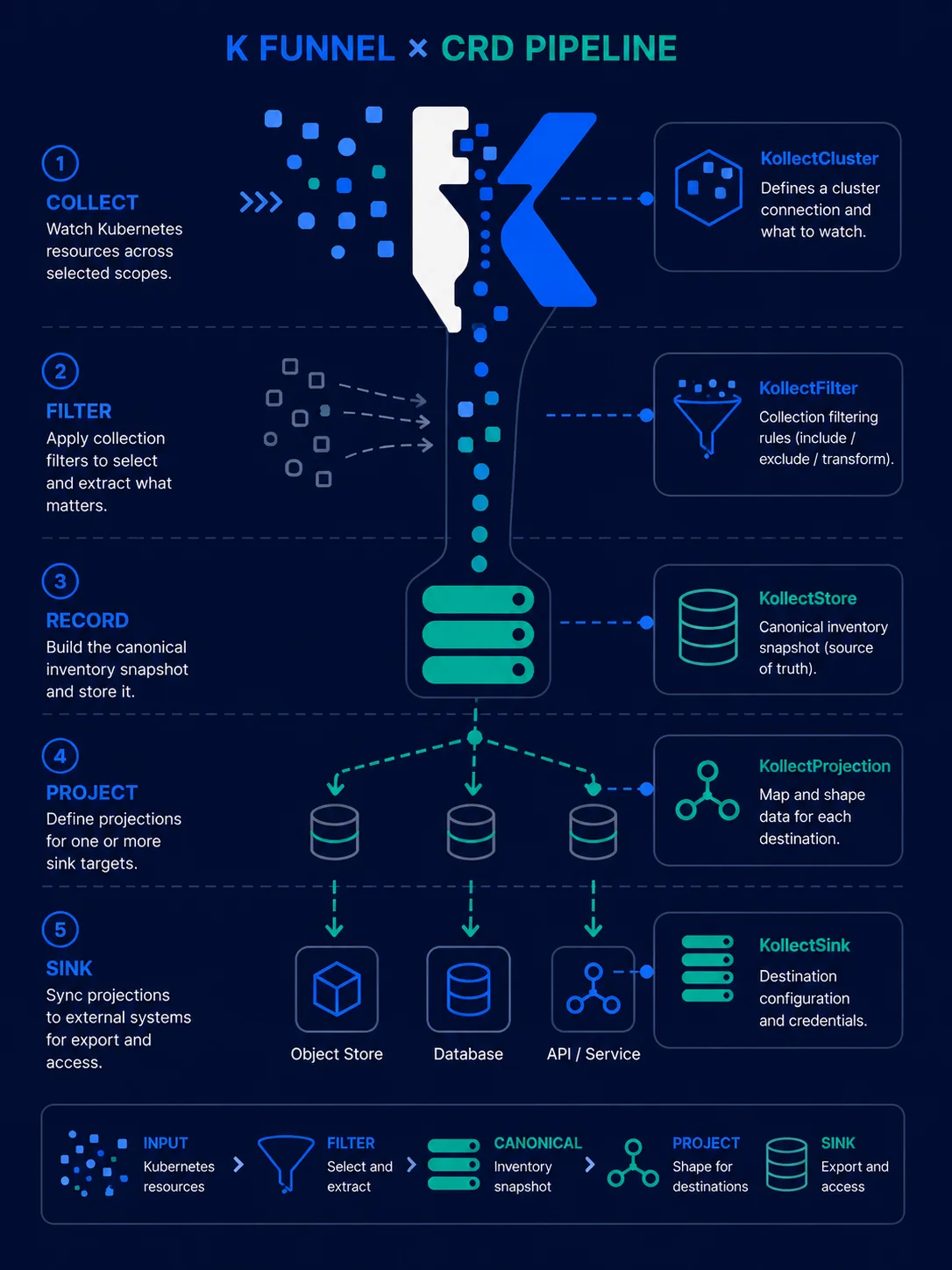
Kollect extends the API with nine kollect.dev/v1alpha1 kinds. You declare what to collect
(KollectProfile), where to export (KollectSink), which resources (KollectTarget), and
how to roll up (KollectInventory). Cluster-scoped kinds (KollectCluster*) add cross-namespace
rollup on platform clusters.
| Term | Meaning |
|---|---|
| CRD | CustomResourceDefinition — schema registered with the apiserver |
| CR | A concrete custom resource instance (your YAML) |
| Reconciler | Controller loop that drives CR .status toward .spec |
| Webhook | Admission validation before create/update (CEL paths, sink enum, scope rules) |
Start here after this page:
- CR-REFERENCE.md — pipeline diagram and per-kind index
- adr/0201-crd-model.md — why these kinds exist
Pre-beta API
Fields and status conditions may change until beta. Check ROADMAP.md before production rollout.
CEL and JSONPath extraction
KollectProfile defines named attributes — field paths evaluated against each watched object.
Cluster targets reference a namespaced KollectProfile by name + namespace
(ADR-0208); there is no KollectClusterProfile
kind. Kollect supports:
- JSONPath — kubectl-style (
{.metadata.name}) or$-prefixed paths; use[*]for all array elements (ADR-0302) - CEL —
cel:-prefixed expressions for computed values and filters
Example attribute row:
attributes:
  - name: image
    path: "{.spec.template.spec.containers[0].image}"
  - name: ready
    path: 'cel:has(object.status.conditions) && object.status.conditions.exists(c, c.type == "Available" && c.status == "True")'
Walkthrough with expected output: examples/deployment-inventory.md.
External references:
- CEL in Kubernetes — language used by admission and Kollect profiles
- JSONPath support in kubectl — path syntax Kollect mirrors
Event-driven informers
Kollect does not poll the API on a cron. For each profile GVK it registers a dynamic informer — shared watches that emit add/update/delete events. Target controllers extract attributes on change; inventory controllers debounce and export to sinks (ADR-0301, DATA-FLOWS.md).
Watch scope
Large clusters need deliberate watchNamespaces, KollectScope, and profile GVK choice.
See PERFORMANCE.md and examples/multi-tenant-watch-namespaces.md.
Export sinks and GitOps context
The in-memory inventory snapshot is canonical; sinks are projections classified by role (ADR-0401):
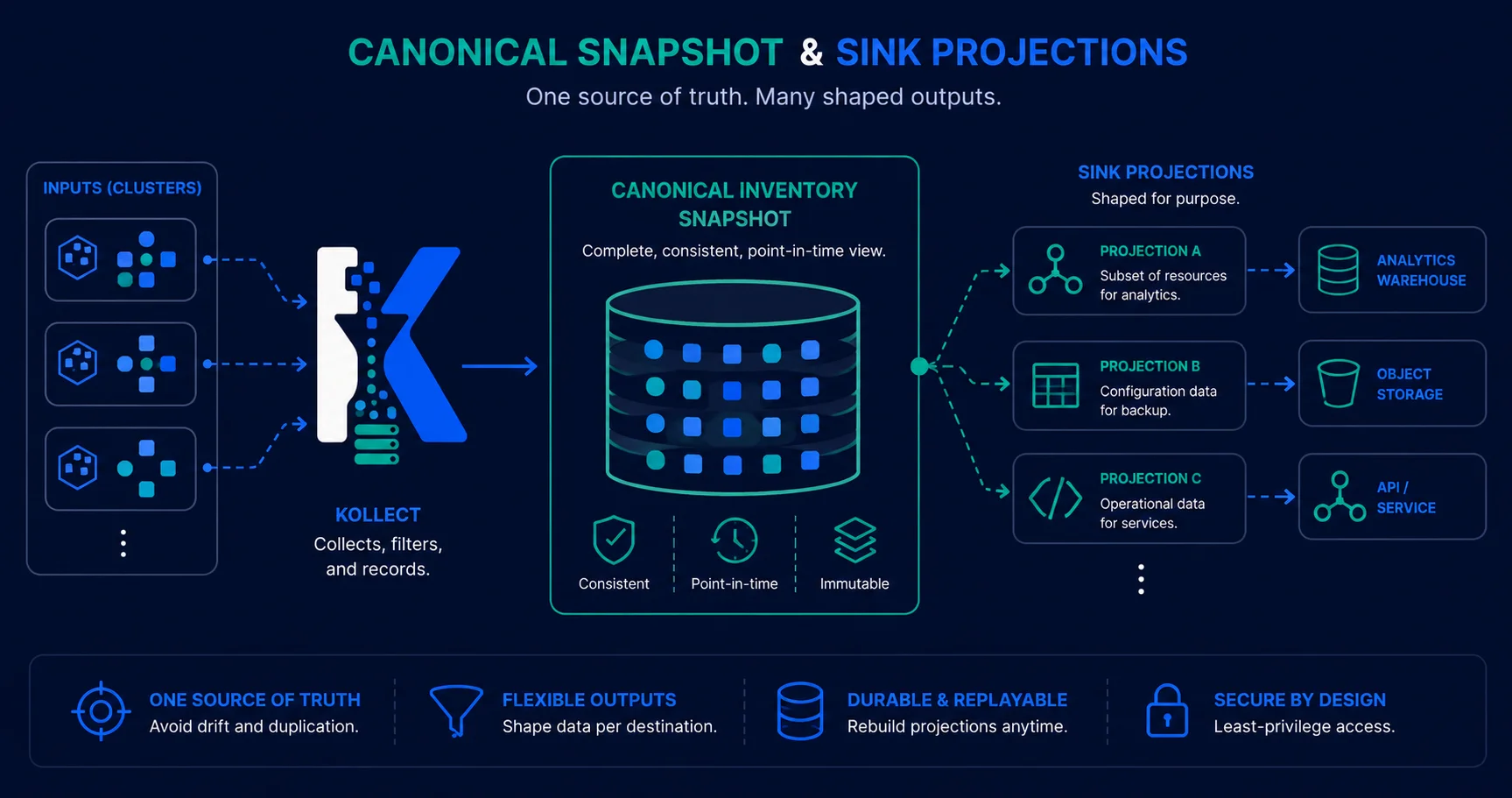
| Role | Shipped spec.type values |
Typical use |
|---|---|---|
| Snapshot store | git, gitlab, s3, gcs |
Auditable JSON history; S3/GCS format: parquet for analytics (ADR-0401) |
| Relational SoR | postgres |
Queryable tables; delete reconciliation removes stale rows |
| Event emitter | nats, kafka |
Change streams for automation and downstream consumers |
Git/GitLab exports produce commits portals and compliance workflows can diff. Postgres holds
queryable state; NATS/Kafka emit events — many teams pair Postgres + NATS in sinkRefs.
See examples/postgres-state-store.md and
examples/nats-event-sink.md.
GitOps-friendly, not a GitOps engine
Kollect exports inventory to Git or other backends; it does not replace Argo CD or Flux. For Helm release inventory, see examples/helm-release-inventory.md.
Multi-cluster (optional)
Single-cluster installs are fully supported. Multi-cluster fleet mode runs one operator per
cluster and partitions shared sinks via spec.cluster and optional spec.pathTemplate
(ADR-0501, ADR-0407,
examples/multi-cluster-fleet.md).
KollectClusterTarget and KollectClusterInventory controllers reconcile cluster-scoped rollup
and export to namespaced sinks.
Next steps
| Goal | Page |
|---|---|
| Install on kind and apply samples | QUICKSTART.md |
| Build, test, and debug locally | DEVELOPMENT.md |
| Architecture and CRD relationships | ARCHITECTURE.md |
| Locked design decisions | PLATFORM-DECISIONS.md |
| Scenario walkthroughs | examples/README.md |