ADR-0203: Namespaced multi-tenancy and operator watch scope
Namespaced-by-default tenancy;
KollectScopehard-degrades a target/inventory that violates it.
Theme: 02 · API & tenancy · Status: Current
Context
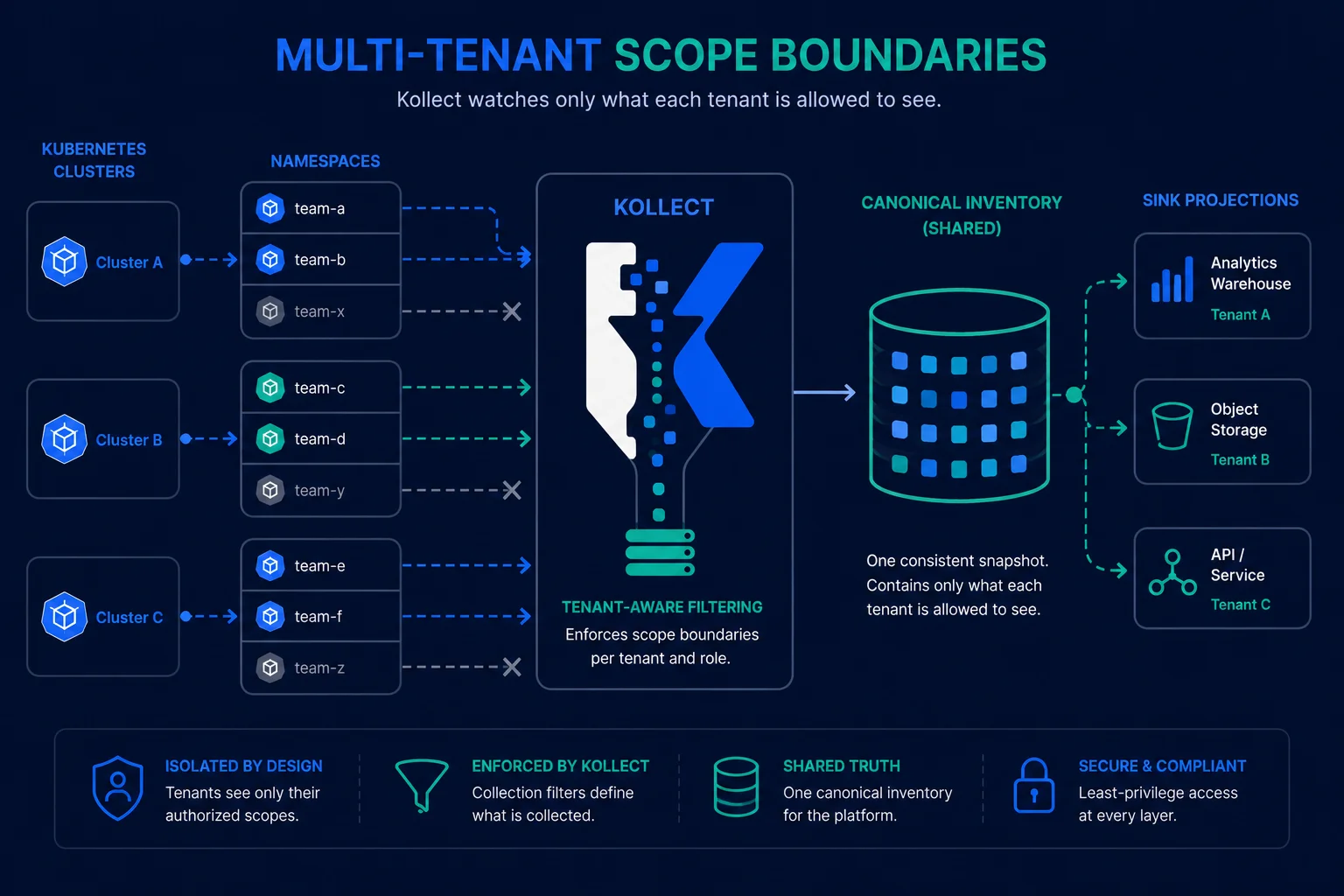
Platform teams need Kollect to run safely alongside many tenant teams on one cluster. Prior art (ADR-0102) compares:
- external-secrets — one cluster-scoped controller reconciling both
ClusterSecretStoreand namespacedSecretStore, plus optional per-namespace controller installs via Helmcontroller.watchNamespaces/scopedNamespace. - Argo CD —
AppProjecttenancy boundary with a single cluster-scoped controller.
Kollect already ships namespaced KollectTarget, KollectInventory, and KollectScope
(ADR-0201). The open question was whether tenancy enforcement and operator
deployment scope should wait until Phase 3.
Decision
Namespaced multi-tenancy is Phase 1 priority (ASAP), not Phase 3.
Support both deployment models. Golden path (default): platform cluster-wide operator
with per-tenant namespaced KollectScope. Team-owned operator installs are supported but
lowest priority for documentation and chart defaults.
| Model | When | Mechanism |
|---|---|---|
| Cluster-scoped manager (golden path) | Platform team operates one shared operator | Watches all namespaces; KollectScope per tenant namespace governs GVKs, workload namespaces, and sink refs |
| Per-team manager | Delegated / team-owned installs | Helm with watchNamespaces: [team-a] and tenantMode: true — namespaced Role RBAC; namespaced Profile/Sink/Target/Inventory in team namespace (ADR-0201) |
Operator watch scope
- Documented default for new installs (golden path): cluster-scoped manager (empty
watchNamespaces) with per-tenantKollectScopeobjects. - Platform option: empty
watchNamespaces→ watches all namespaces (cluster-scoped operator). - Team-scoped (supported, lowest doc priority): non-empty
watchNamespaces+tenantMode: true→cache.Options{DefaultNamespaces}restricts informers and reconcilers to those namespaces only (controller-runtime cache options).
RBAC expectations
- CRD install requires cluster-level permissions (standard for any operator).
- Reconciler runtime for team-owned installs must work with namespace-scoped Role RBAC only
when
tenantMode: true— no cluster-wide list/watch beyond what cluster owners accept for CRD bootstrap. - Platform golden-path installs use ClusterRole as today.
Overlapping operator installs
Multiple independent operator deployments may watch the same GVK/namespace data intentionally. Kollect does not enforce namespace ownership or reject overlapping watch scopes via webhook. Operational policy and optional sink dedupe (ADR-0305) are the backstop when duplicate collection is undesirable — not admission guardrails. See the deployment topology matrix for path comparison and the multi-operator dedupe runbook.
Helm values:
watchNamespaces: []          # empty = all namespaces
tenantMode: false            # true → Role instead of ClusterRole for the manager SA
Manager flag: --watch-namespaces=team-a,team-b (comma-separated).
KollectScope (namespaced, static)
- Scope: namespaced (ADR-0201); one object per tenant namespace.
- Validation: validating webhook rejects invalid GVK entries, duplicate
sinkRefs, and blank allowlist entries at admission (ADR-0202). - Enforcement (Phase 1): both validating webhook and reconciler-time checks — hard
degrade (no collection / no export) when a
KollectTargetorKollectInventoryviolates scope. SetDegraded=Truewith reasonScopeGVKDenied,ScopeNamespaceDenied, orScopeSinkDenied; emit Warning event. Do not soft-warn and continue reconciling forbidden config.
KollectClusterScope remains reserved for platform-wide policy when namespaced scope is
insufficient (ADR-0201). Frozen/minimal — no new behavioral knobs without
a concrete platform blocker.
KollectClusterInventory federation
Platform rollups use KollectClusterInventory to compose namespace snapshots/shards — explicit
federation, not implicit whole-cluster capture:
spec.namespaces(optional): explicit namespace names when set; empty or absent carries documented semantics (not a required field)- Optional namespace selectors for additive discovery when enabled
- Rollup export built from shard references; status should eventually expose per-namespace shard metadata (see ROADMAP.md)
Enforcement example (GVK denied)
KollectScope in team-a allows only apps/v1 Deployment. A team applies a KollectTarget whose
profileRef resolves to a Profile targeting Flux HelmRelease:
# team-a/kollectscope.yaml — allowlist
apiVersion: kollect.dev/v1alpha1
kind: KollectScope
metadata:
  name: team-a-scope
  namespace: team-a
spec:
  allowedGVKs:
    - group: apps
      version: v1
      kind: Deployment
  allowedNamespaces: [team-a]
  sinkRefs: [team-a-postgres]
---
# team-a/kollecttarget.yaml — violates allowedGVKs
apiVersion: kollect.dev/v1alpha1
kind: KollectTarget
metadata:
  name: helm-releases
  namespace: team-a
spec:
  profileRef: helm-release-summary   # Profile targets helm.toolkit.fluxcd.io/HelmRelease
Outcome: Target reconciler does not register the informer watch. Status:
status:
  conditions:
    - type: Degraded
      status: "True"
      reason: ScopeGVKDenied
      message: 'profile GVK "helm.toolkit.fluxcd.io/v2/HelmRelease" not in scope allowedGVKs'
Inventory sink denied — same pattern when spec.sinkRefs lists a sink not in
KollectScope.spec.sinkRefs (ScopeSinkDenied). Envtest: internal/controller/kollecttarget_scope_test.go.
Consequences
Positive
- Teams can adopt Kollect early with explicit tenancy boundaries.
- Platform can offer either shared or per-team operator installs without forking the binary.
- Overlapping multi-operator installs are allowed — no false sense of exclusive namespace ownership.
- Aligns with ESO and Flux Helm patterns operators already understand.
Negative
- Two deployment models require chart and doc clarity to avoid misconfigured RBAC.
- Overlapping collection when multiple operators watch the same scope is possible — operators must plan sink dedupe or accept duplicate rows (ADR-0305, topology matrix).
- Resolved (ADR-0204):
KollectProfilemoves to namespaced scope sotenantModeinstalls do not need cluster profile RBAC;KollectClusterProfilereserved for platform-shared schemas. - Reconciler enforcement adds controller complexity and must stay consistent with webhook rules.
Open questions
- RESOLVED: Family sink CRDs ship with namespaced + cluster variants;
KollectCluster*Sinkkinds are retained long-term — not removed pre-v1 (ADR-0414).