ADR-0401: Sink taxonomy — state stores vs event emitters
Sinks classified by role — snapshot store, relational SoR, event emitter. The in-memory snapshot is canonical.
Theme: 04 · Export & sinks · Status: Current
Context
Postgres and Kafka serve different roles: Postgres answers "what is deployed now?" (queryable state); Kafka answers "what changed?" (event log). Listing them as co-equal "primary sinks" (ADR-0402) obscures that distinction.
Multi-cluster fan-in uses direct shared-sink export with spec.cluster
(ADR-0501) — no operator merge tier.
Critical gaps addressed in this ADR:
- Role clarity — classify backends as snapshot store, relational SoR, or event emitter.
- Postgres deletes — upsert-only drifts when resources disappear; delete reconciliation is required.
- Event emitters — NATS JetStream (lean default) and Kafka (enterprise opt-in) share one abstraction.
Decision
1. Classify sinks by role, not by vendor
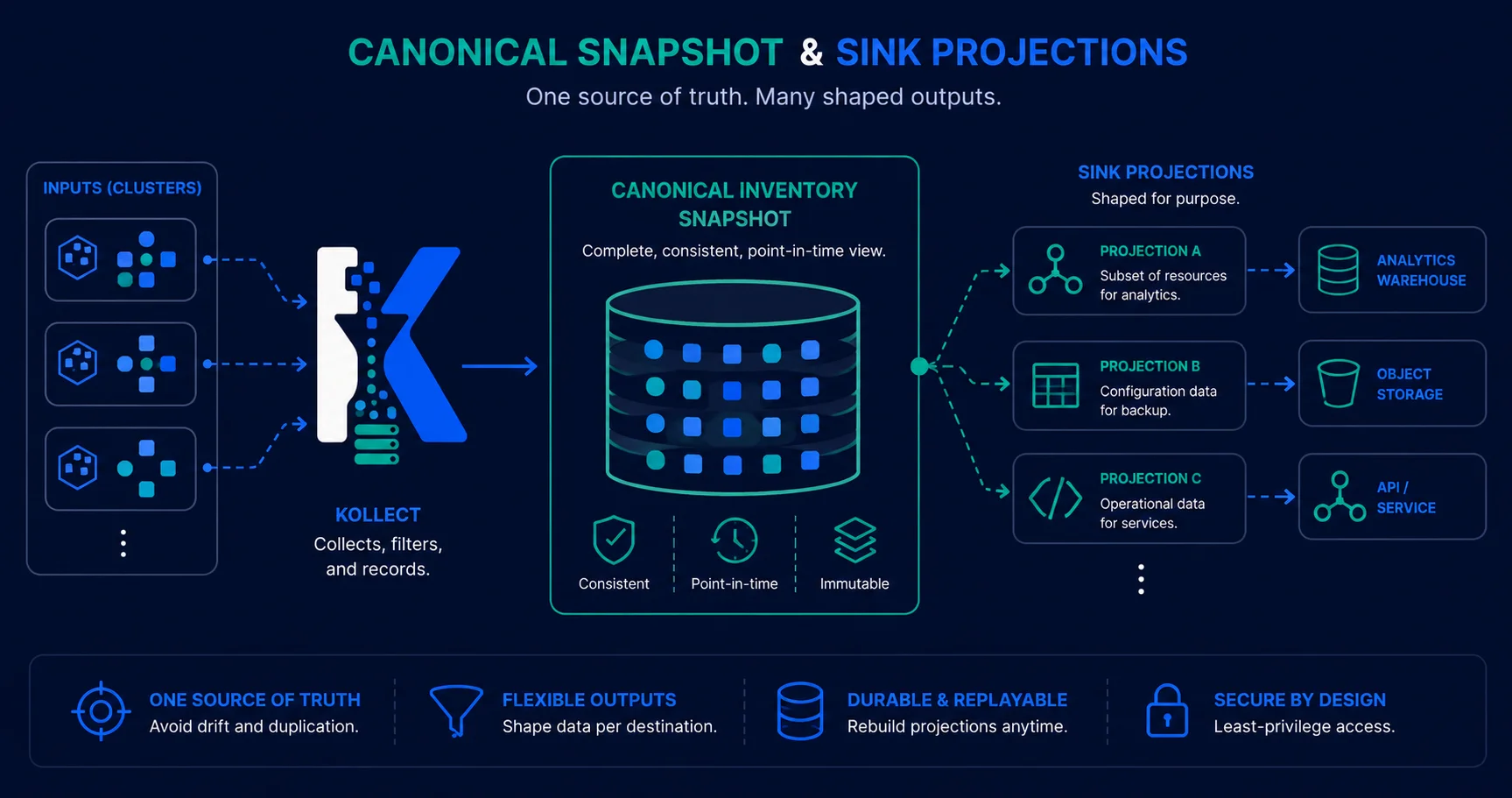
| Role | Backends | Answers | Deletes |
|---|---|---|---|
| Snapshot store | Git, S3/GCS Parquet, HTTP | current state, written whole each cycle | free (absent = deleted) |
| Relational SoR | Postgres | current state, rich SQL/joins for portals | requires delete reconciliation |
| Event emitter | NATS JetStream (lean default), Kafka/Redpanda (enterprise opt-in) | change stream for downstream integration | tombstone (consumer-owned) |
The in-memory snapshot per KollectInventory is the canonical artifact. Every sink is a
projection of it. Snapshot stores serialize it directly; relational/event sinks derive from it via a
shared diff step.
2. S3/GCS Parquet snapshot sink (queryable without a database)
Write one Parquet file per inventory per export, partitioned:
s3://bucket/inventory/cluster=<c>/ns=<ns>/name=<inv>/generation=<g>.parquet
- "Current inventory" = the latest generation per partition (documented view/macro).
- Queryable by DuckDB / Athena with no database server — predicate pushdown + partition pruning read only needed byte ranges.
- Deletes are correct by construction — absent from the latest snapshot = gone.
- Arbitrary profile attributes serialize to a JSON/struct column (DuckDB queries JSON natively).
- Frequent exports → many small files: rely on
exportMinInterval(default 30s) and document a periodic compaction job. ACID update-in-place (Iceberg/DuckLake) is out of scope — Kollect overwrites whole snapshots, so no table catalog/metadata DB is required.
This is the recommended "small/medium platform wants queryable inventory without running a DB" option, complementing Git (audit) and Postgres (rich relational portal).
3. Postgres gains delete reconciliation
The Postgres sink must diff the current snapshot against the prior export per (cluster, inventory)
and delete rows for resources no longer present (or write a deleted_at tombstone). Upsert-only
is a correctness bug.
4. Event emit: NATS default, Kafka opt-in
- NATS JetStream is the lean default event backbone — single binary, sub-ms latency.
- Kafka (and Redpanda via the Kafka API) is the enterprise opt-in when an org already operates Kafka connectors and schema registry.
- Multi-cluster fan-in: each operator publishes to a shared NATS/Kafka destination with a cluster label (ADR-0501).
5. Multi-cluster = shared sink
Direct shared-sink fan-in is the fleet topology: each operator exports with spec.cluster set;
Postgres PK, Git pathTemplate, or event subject provides merge semantics
(ADR-0501).
Consequences
Positive
- Honest model: state stores vs event emitters, not redundant twin primaries.
- Parquet snapshot gives queryable inventory with no server and correct deletes.
- One event-emitter abstraction (NATS/Kafka) with clear fleet fan-in story.
- Most multi-cluster installs use shared sinks only — no aggregation tier in the operator.
Negative
- New Parquet writer dependency + attribute→column mapping; compaction guidance needed.
- Postgres delete-reconciliation is new logic (diff vs last export).
- NATS is a new system for Kafka-only shops; mitigated by Kafka opt-in.
- Sink enum gains
nats; object-store sinks gain aformat: parquetmode — codegen + webhook + tests.
Related
Open questions
- DECIDED : Parquet schema is hybrid — typed identity columns (
cluster,namespace,name,uid,group/version/kind,exportedAt) + a JSON/variantattributescolumn, and a promoted allowlist of hot attributes (e.g.image,version) materialized as typed columns from the start. Stable across profiles; no per-profile schema migration (ADR-0405). - DECIDED: The NATS emit channel is a JetStream stream (not KV) — durable, replayable,
with
Nats-Msg-Iddedupe. - OPEN: Compaction — operator-run job, external (S3 Tables auto-compaction), or documented only?